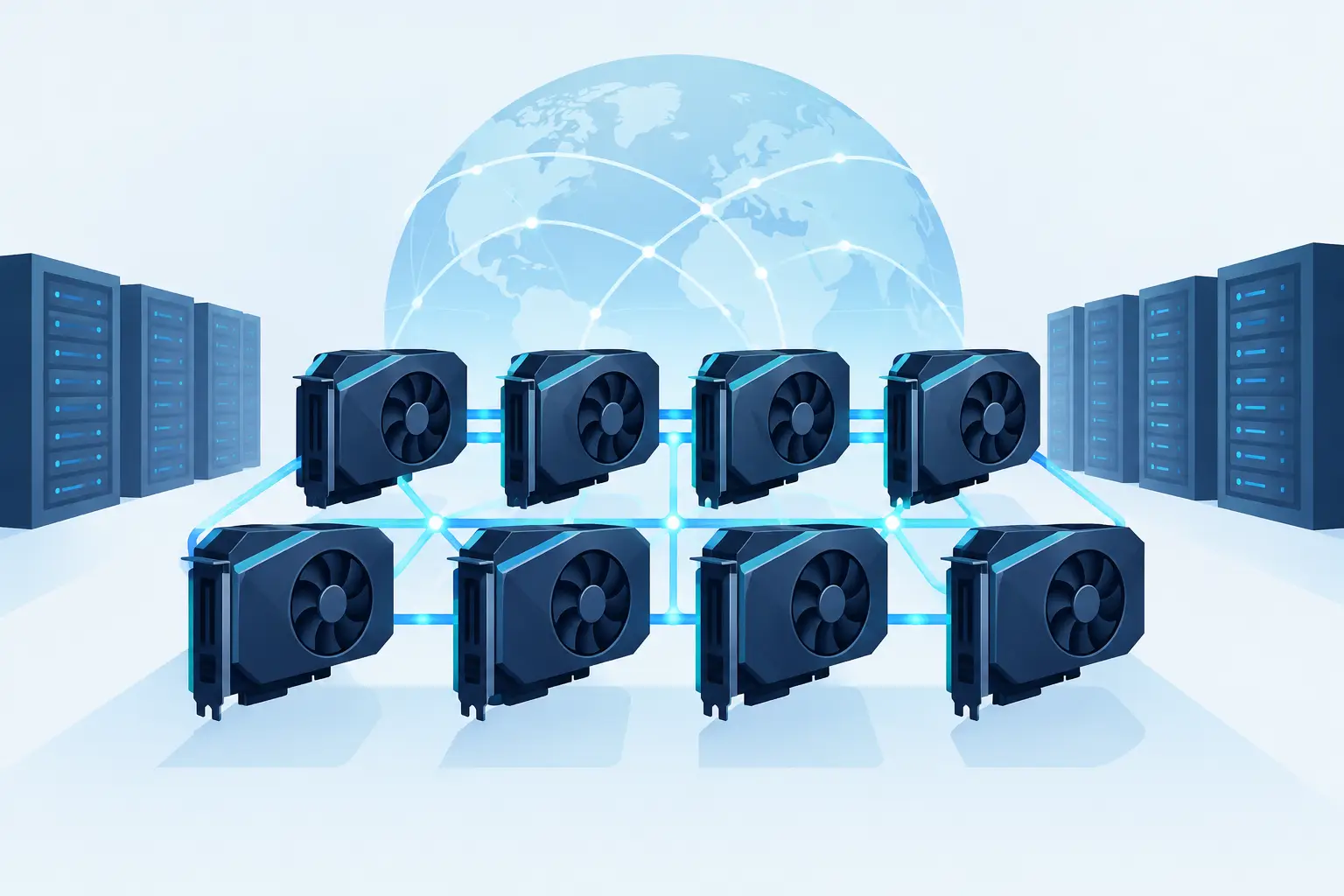
GPU Interconnects and the Architecture of Scale
A large GPU count is not a computational architecture. It is a collection of accelerators whose value depends on how effectively they exchange data. GPU interconnects determine whether a training cluster behaves as a coherent machine or as a set of expensive islands waiting on communication. For AI at scale, simulation, and other distributed numerical workloads, the network is not peripheral infrastructure. It is part of the computational method.
This distinction becomes visible as soon as a workload crosses a single accelerator boundary. Model parameters, activations, gradients, state vectors, and intermediate results must move among GPUs with predictable latency and sustained bandwidth. If the interconnect fabric is poorly matched to the workload, increasing the number of GPUs can lower efficiency rather than improve time to solution.
GPU Interconnects Define the Scaling Boundary
Modern accelerated systems operate across at least two scaling domains. Scale-up describes communication among GPUs within a server or tightly integrated compute domain. Scale-out describes communication across servers, racks, and often multiple failure and administrative domains. These domains have different physical constraints, protocol overheads, and economic implications.
Within a node, PCIe remains foundational because it connects CPUs, GPUs, storage devices, and network adapters through a broadly supported standard. Its utility is unquestioned, but it was not designed exclusively for the dense, repeated GPU-to-GPU exchanges required by large distributed training jobs. PCIe topology matters substantially: GPUs placed behind different CPU sockets or PCIe switches can encounter unequal paths, additional hops, and NUMA-related memory effects.
Dedicated GPU fabrics such as NVLink address a different class of problem. They provide high-bandwidth peer connectivity among supported accelerators, reducing dependence on host-mediated transfers and making collective operations more efficient. NVSwitch extends this principle by creating a larger, more uniform connectivity domain inside a server or appliance-scale system. For workloads that repeatedly synchronize across many GPUs, this can materially change the feasible model size, batch strategy, and elapsed training time.
Yet scale-up capacity is finite. The moment a job extends beyond a single compute domain, the architecture depends on a scale-out fabric. InfiniBand has long occupied this role in high-performance computing and increasingly in large AI systems because it offers low latency, high throughput, remote direct memory access, and mature support for communication collectives. High-performance Ethernet, particularly where RDMA and congestion-control capabilities are engineered correctly, can also support demanding AI workloads while fitting more naturally into existing enterprise network operating models.
The correct question is not whether one protocol is categorically superior. It is whether the fabric sustains the communication pattern imposed by the workload at the intended scale and with an operating model the organization can maintain.
Bandwidth Alone Does Not Describe the Fabric
Procurement discussions often begin and end with port speed. This is insufficient. A 400 Gb/s or 800 Gb/s interface indicates potential line rate, not application-level communication performance. The realized behavior of GPU interconnects depends on topology, oversubscription, switch buffering, congestion control, host placement, routing behavior, and collective communication libraries.
Latency is decisive for synchronization-heavy operations, particularly all-reduce patterns used in data-parallel training. A training step cannot complete until participating ranks reach the relevant synchronization point. Small, recurrent delays can accumulate across thousands of iterations, leaving accelerators underutilized despite impressive theoretical bandwidth.
Bisection bandwidth is equally relevant. It measures the capacity available when the system is divided into two comparable halves and traffic crosses between them. A fabric with inadequate bisection bandwidth may perform acceptably for independent inference requests or loosely coupled batch jobs, then deteriorate sharply under synchronized training or tightly coupled simulation. The distinction is architectural, not cosmetic.
Topology determines how these properties manifest. A nonblocking fat-tree can offer predictable all-to-all communication characteristics but requires significant switching capacity and cabling discipline. Dragonfly-style and other hierarchical designs can improve cost and physical efficiency at larger scales, but their behavior must be evaluated against expected traffic patterns. A topology that is reasonable for domain-decomposed simulation may be less suitable for workload phases that induce broad all-to-all exchanges.
The Workload Must Lead the Design
Interconnect design should begin with a communication profile, not a vendor datasheet. Data-parallel training is often dominated by gradient synchronization. Tensor parallelism creates high-frequency exchanges within a model layer. Pipeline parallelism shifts the emphasis toward activation transfer between stages. Mixture-of-experts architectures can introduce irregular routing and all-to-all communication that exposes congestion weaknesses quickly.
Scientific and industrial computing presents a similarly varied picture. Computational fluid dynamics, molecular simulation, seismic processing, and finite-element workloads may exchange halo regions, perform global reductions, or generate bursty checkpoint traffic. Neural operator frameworks and hybrid physics-ML pipelines add their own demands, often combining high-throughput learning phases with data-intensive preprocessing and storage access.
This is why average bandwidth utilization is a weak planning metric. Architecture must account for communication peaks, message size distributions, collective algorithms, checkpoint intervals, and the degree to which compute can overlap with communication. A system sized for average behavior is often undersized precisely when its most valuable jobs run.
Collective Libraries Are Part of the System
NCCL, MPI, UCX, and related communication layers translate logical operations into physical data movement. Their performance depends on accurate topology discovery, appropriate transport selection, peer access, NIC affinity, and version compatibility across drivers, firmware, operating systems, and container runtimes.
A fabric can be technically capable yet operationally underperform because GPU-to-NIC mappings are wrong, traffic traverses an unintended PCIe path, or collective libraries select suboptimal communication rings. These issues are not minor tuning details. They define the difference between an architecture that delivers its modeled performance and one that consumes engineering time indefinitely.
For this reason, production validation should include representative distributed workloads rather than synthetic point-to-point benchmarks alone. Measure step time, scaling efficiency, tail latency, retransmission or congestion events, and the variance between identical runs. A stable result at 64 GPUs has more strategic value than a short-lived benchmark peak achieved under ideal conditions.
Designing for Fault Domains and Operational Endurance
The highest-performing topology is not automatically the best enterprise architecture. Dense fabrics increase dependency between components. A switch failure, firmware defect, or configuration error can affect a broad computational domain. Conversely, excessive segmentation can constrain workload placement and create stranded capacity.
The appropriate boundary depends on job duration, checkpoint behavior, availability requirements, and the organization’s tolerance for operational complexity. Long-running training campaigns may justify high-redundancy core paths and carefully designed maintenance windows. Research environments with heterogeneous experimental workloads may benefit from modular partitions that limit blast radius while preserving access to shared storage and scheduling services.
Storage architecture must be considered alongside the GPU fabric. Checkpoint storms can contend with training traffic if network paths, adapters, or switches are shared without sufficient capacity planning. A cluster may exhibit excellent collective performance until every job writes state simultaneously. Separating traffic classes, designing explicit quality-of-service policies, and testing failure and recovery behavior are often more valuable than pursuing marginally higher nominal throughput.
Security and observability also belong in the design. High-performance fabrics require visibility into link health, error counters, congestion behavior, route consistency, and GPU communication utilization. Without this telemetry, teams often discover degradation only after researchers report inconsistent training times. Intelligent observability turns the interconnect from an opaque substrate into an auditable engineering system.
A Disciplined Selection Framework
Organizations evaluating GPU interconnects should establish the intended computational unit first: an eight-GPU server, a 32-GPU pod, a multi-rack training domain, or a larger shared research platform. They should then model the dominant workload classes, expected parallelization methods, dataset location, and target utilization rather than treating all accelerator demand as interchangeable.
The next decision concerns the balance between scale-up and scale-out investment. A dense internal GPU fabric can reduce communication costs inside a node, but it does not remove the need for a carefully engineered external network. Similarly, a powerful cluster fabric cannot compensate fully for poor intra-node placement or asymmetric PCIe connectivity. Performance emerges from the composition of these layers.
ELDEF approaches this as a systems-design problem: compute, network, storage, scheduling, and model execution must be analyzed as one computational ecosystem. The objective is not maximal hardware density. It is sustained, measurable capability under real research and production conditions.
A durable GPU fabric is built when every interconnect decision can be traced to a known workload behavior, an explicit scaling target, and a validated operational assumption. That discipline gives technical leaders a practical next step: benchmark the communication patterns that matter before the cluster design becomes irreversible.


Comments