Enterprise AI Infrastructure Trends That Matter
A GPU purchase order is not an AI strategy. Yet many enterprise programs still treat compute acquisition as the decisive step, only to encounter data bottlenecks, low accelerator utilization, uncontrolled model replication, and inference costs that overwhelm the original business case. The defining enterprise AI infrastructure trends are therefore less about adding hardware than about designing a computational system that can sustain research, deployment, governance, and operational change at once.
For institutional and industrial leaders, the question is no longer whether AI requires substantial infrastructure. It does. The harder question is which architecture converts that infrastructure into repeatable capability without creating an expensive, opaque, and brittle estate.
Enterprise AI Infrastructure Trends: From Capacity to Architecture
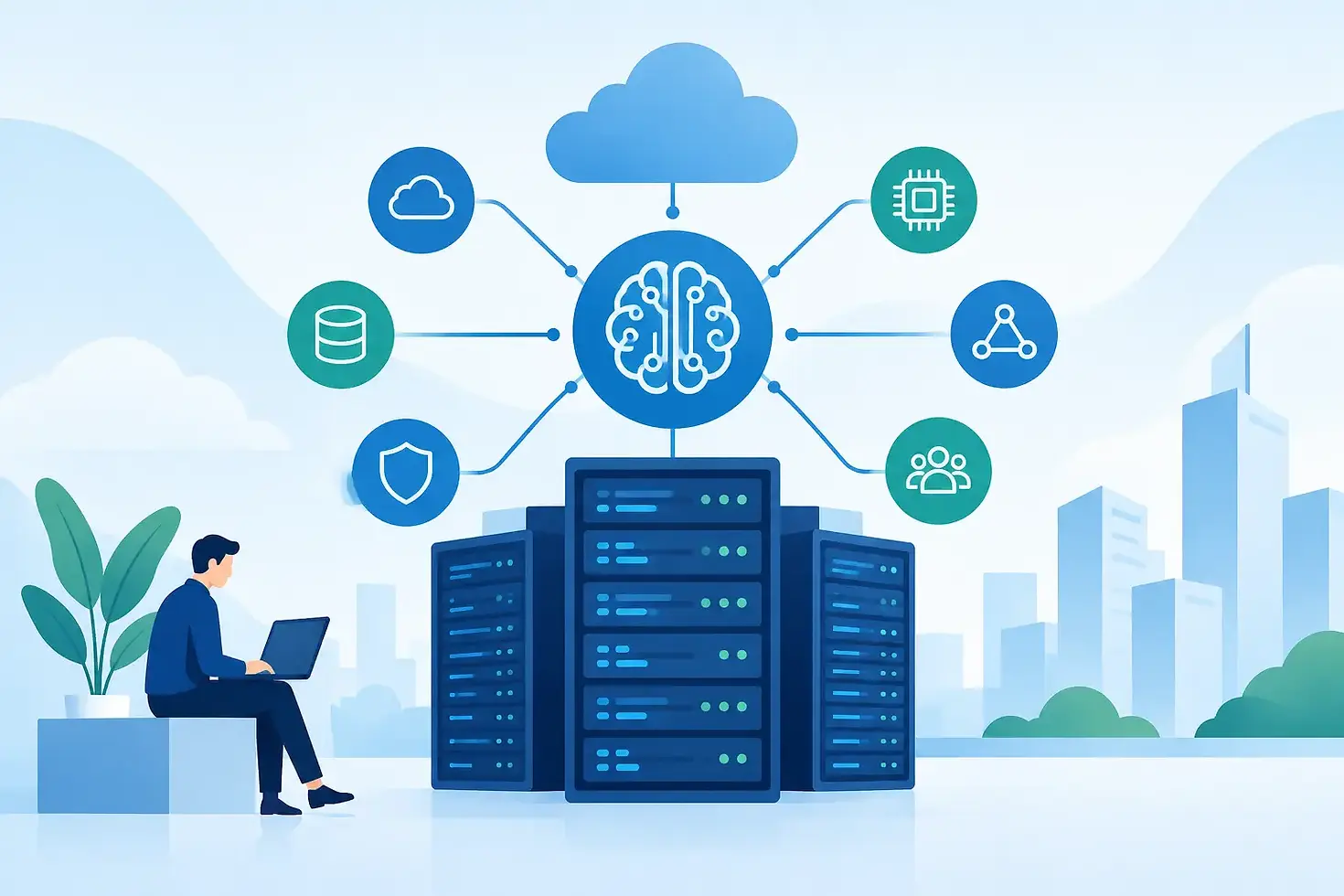
The first shift is conceptual. Enterprise AI infrastructure is becoming an architectural discipline rather than a capacity-planning exercise. A cluster is valuable only when its network topology, storage behavior, scheduling policies, software environment, observability, and security boundaries work as one computational fabric.
This matters because model workloads are structurally different from conventional enterprise applications. Distributed training generates intense east-west traffic among accelerators. Data preparation can be storage- and CPU-bound long before a model reaches the GPU layer. Fine-tuning requires reproducible environments and lineage. Production inference may demand predictable latency, geographic placement, and cost controls that are irrelevant to a research experiment.
A single generalized platform can serve several of these needs, but only if its abstractions are deliberate. Treating every workload as an identical containerized job often hides the properties that determine performance: interconnect contention, memory pressure, checkpoint behavior, data locality, and queue policy. The result is an environment that appears modern on an architecture diagram but wastes expensive compute in operation.
The stronger pattern is a workload-aware compute fabric. It provides differentiated paths for exploratory development, distributed training, high-throughput batch work, real-time inference, and simulation-driven AI. This does not necessarily mean building isolated silos. It means recognizing that shared infrastructure requires explicit service classes, scheduling logic, and performance guarantees.
GPU Clusters Are Becoming Engineered Fabrics
GPU density remains central, but the relevant unit of design is increasingly the fabric rather than the server. Accelerator generations advance quickly; poor interconnect design, fragmented storage, and weak orchestration create constraints that persist much longer.
For large training jobs, bandwidth and collective communication efficiency can determine whether additional GPUs improve time to result or merely increase cost. Network design must be evaluated against actual communication patterns, not generic throughput claims. The same principle applies to storage. A high-capacity data lake does not automatically provide the metadata performance, parallel reads, checkpoint throughput, or locality controls demanded by training pipelines.
This is driving renewed attention to composable architectures that join accelerated compute, high-performance storage, fast networking, and schedulers under a common operational model. The aim is not maximum theoretical performance. It is predictable performance under mixed demand.
There is a trade-off. Highly optimized fabrics can become difficult to evolve if every layer is tightly coupled to a single vendor or model framework. Conversely, broad abstraction can reduce operational friction but leave substantial performance unrealized. The appropriate balance depends on whether the enterprise is operating frontier-scale training, specialized domain models, simulation workloads, or high-volume inference.
Scheduling becomes an economic control plane
As accelerators become a constrained and costly resource, scheduling is moving from administrative utility to strategic control plane. Queueing rules, reservation policies, priority classes, quotas, and preemption decisions directly affect research velocity and financial discipline.
A mature scheduler should expose utilization in terms that technical and business leaders can both interpret. Idle GPU hours, failed jobs, time spent waiting for data, excess replica counts, and cost per successful inference are more actionable measures than aggregate cluster utilization alone. A cluster can report high utilization while producing little value if jobs are poorly sized or repeatedly fail at the data and environment layers.
Data Architecture Is Now Part of AI Performance
The assumption that data is simply fed into models has become untenable. AI systems depend on a data architecture that manages movement, quality, permissions, lineage, retention, and retrieval at machine scale. Without it, model performance and operational reliability become difficult to validate.
The enterprise trend is toward data planes that treat datasets, feature definitions, embeddings, training corpora, vector indexes, and model artifacts as governed computational assets. This requires more than cataloging. It requires a clear answer to where each asset resides, which process created it, who may use it, and whether it can be reproduced under an audit or incident review.
Data locality is equally consequential. Moving large datasets repeatedly between object storage, processing nodes, and accelerators introduces delay, network expense, and exposure risk. In some environments, the answer is cache-aware scheduling or high-throughput parallel storage. In others, it is regional placement or a hybrid design that keeps regulated data near its system of record. There is no universal topology, but there is a universal requirement: data movement must be designed rather than tolerated.
MLOps Is Expanding Into Model Operations
The boundaries between MLOps, platform engineering, and security operations are narrowing. A model is not operational merely because it has been deployed behind an API. Its runtime dependencies, evaluation results, prompts or retrieval sources, access policies, latency profile, and rollback path must all be known and controlled.
This is particularly acute for generative AI. Retrieval-augmented systems introduce dependencies on document pipelines, embedding models, vector stores, access controls, and evaluation frameworks. A change to any one layer can alter output quality or expose information that the base model never contained. Model operations must therefore observe the full execution path, not only the endpoint.
A durable platform establishes model registries, environment promotion controls, reproducible build processes, policy gates, and evaluation criteria appropriate to the use case. For a document-assistance system, grounding accuracy and citation behavior may matter most. For industrial forecasting, calibration drift, uncertainty bounds, and the relationship between predictions and physical constraints may be more consequential.
The trend is away from generic lifecycle tooling toward evidence-based operation. Teams need to demonstrate why a model was approved, what data supported the decision, how it behaves under representative conditions, and how degradation will be detected.
Governance Is Becoming a Design Constraint
Governance is often introduced after an AI system proves useful. That sequence is costly. When identity, tenancy, data classification, auditability, and residency requirements arrive late, they can force a redesign of the data plane, deployment model, and operating procedures.
The more effective approach embeds governance in the architecture. Access should be defined across infrastructure, data, model, and application layers. Observability should capture not only infrastructure metrics but also model behavior, policy events, and material changes in input distributions. For regulated or research-intensive organizations, this creates an evidentiary chain from source data through model release to production outcomes.
Sovereignty is also becoming more specific. It is not solved solely by locating servers within a region. Enterprises must understand administrative control, support access, encryption key custody, model-provider dependencies, and the jurisdictions governing operational metadata. The appropriate design may be private infrastructure, a sovereign cloud arrangement, hybrid placement, or a carefully bounded use of external model services.
Efficiency Is a Systems Property
Energy, cooling, and rack power are now direct architectural concerns. High-density AI infrastructure can exceed assumptions embedded in legacy data center designs, while inference demand can grow more rapidly than planned training capacity. The operational consequences include power constraints, thermal design changes, capacity delays, and volatile unit economics.
Efficiency should not be reduced to selecting lower-power hardware. It emerges from model choice, quantization, batching, caching, routing, utilization, data movement, and retirement of unused artifacts. A smaller specialist model may outperform a general model for a constrained industrial task. A hybrid routing layer may reserve expensive inference for ambiguous cases. These are architectural decisions with measurable economic and environmental effects.
For ELDEF, this is where engineering intelligence matters most: performance, resilience, governance, and efficiency must be resolved as interdependent system properties, not separate procurement workstreams.
The enterprises that build enduring AI capability will not be those that acquire the largest pool of accelerators. They will be those that define the workloads that matter, instrument the constraints that govern them, and build a computational foundation capable of adapting as models, data, and operational demands change.


Comments