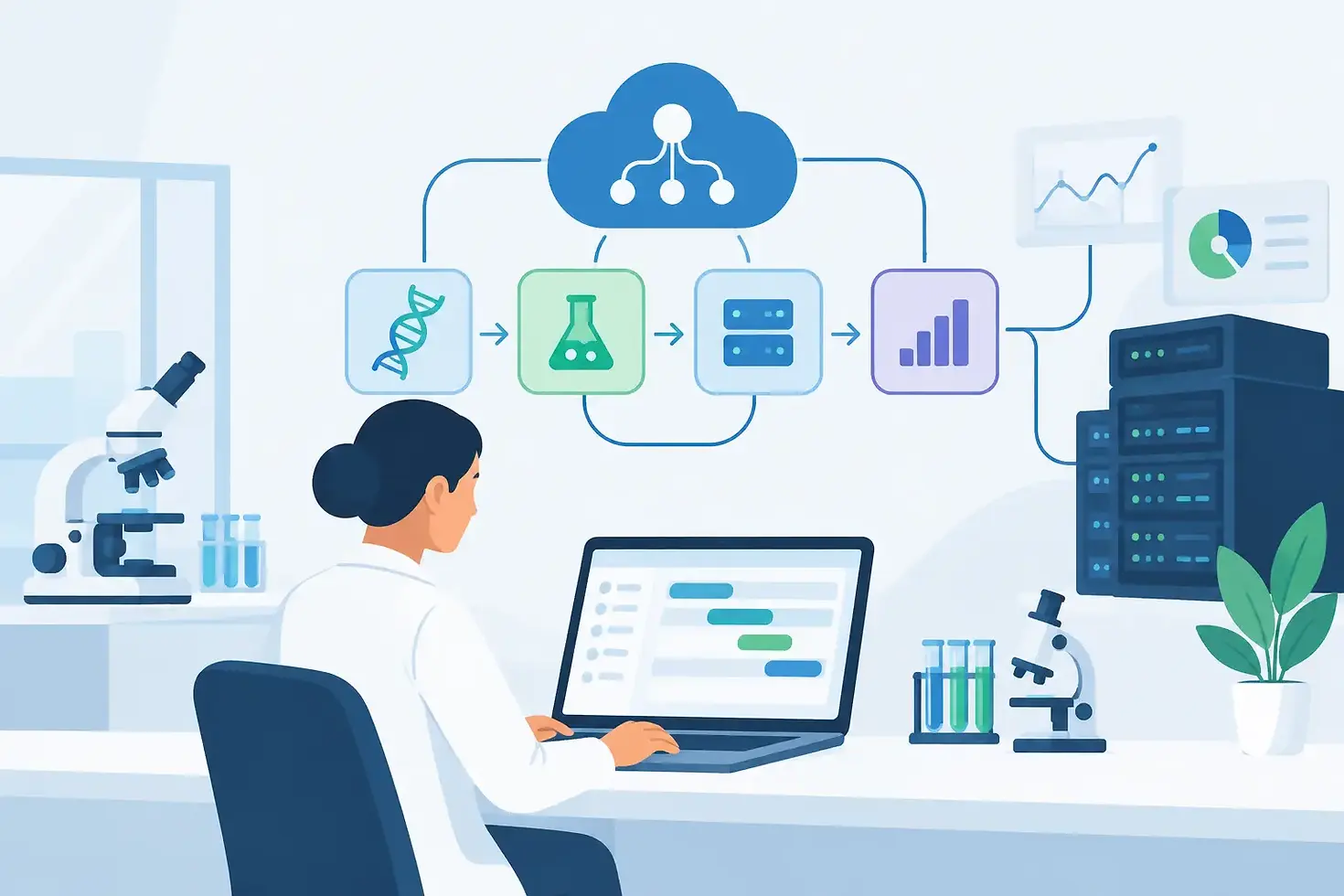
A Scientific Workload Orchestration Guide
A simulation that reaches 94% completion before failing on an exhausted scratch volume is not merely an infrastructure incident. It is a failure of computational coordination. The same is true when an AI training run monopolizes GPUs needed for an urgent inference validation, or when a laboratory cannot reproduce a published result because the execution environment has changed. A scientific workload orchestration guide begins with this premise: computational throughput is governed not only by available compute, but by the rules that direct work through the system.
For research-intensive enterprises, orchestration is the control plane that connects scientific intent to executable, observable, and repeatable computation. It determines what runs, where it runs, with which data, under what resource constraints, and how its outputs become trustworthy inputs to the next stage. Done well, it turns heterogeneous infrastructure into an enduring computational capability. Done poorly, it creates expensive queues, irreproducible results, and operational fragility hidden beneath apparently powerful hardware.
What Scientific Workload Orchestration Must Control
Scientific workloads differ from conventional application jobs because their requirements are rarely uniform. A computational fluid dynamics campaign may require tightly coupled MPI processes and high-bandwidth interconnects. Molecular dynamics may generate large checkpoint files at predictable intervals. Neural operator training may demand GPUs, high-throughput storage, and carefully versioned datasets. Parameter sweeps may consist of thousands of independent tasks whose value depends on efficient scheduling rather than low-latency communication.
An orchestration architecture must understand these distinctions without forcing every workload into the same execution model. Its role is not simply to submit jobs to a scheduler. It must coordinate the lifecycle of computation across resource allocation, data staging, environment definition, failure handling, provenance capture, policy enforcement, and output publication.
This is why a batch scheduler alone is necessary but insufficient. Slurm, PBS, Kubernetes, workflow engines, experiment trackers, artifact registries, and observability platforms may all have a role. The architectural question is how these components share a coherent operating model. A fragmented stack can automate isolated tasks while leaving the most consequential transitions - from data preparation to model execution to scientific review - dependent on manual intervention.
Treat workloads as computational products
The useful unit of design is not the cluster job. It is the computational product: a versioned process that transforms governed inputs into interpretable outputs under specified conditions. This framing brings rigor to work that otherwise becomes a collection of scripts, container images, and tribal knowledge.
Each computational product should declare its resource profile, software environment, input contracts, output contracts, quality checks, and retention requirements. The declaration need not be burdensome. It must, however, be precise enough for the platform to make correct scheduling and operational decisions.
A training workload, for example, should state whether it can resume from checkpoints, whether distributed workers require topology-aware placement, which dataset version it consumes, and which metrics determine successful completion. A simulation workflow should identify its mesh dependencies, solver configuration, numerical tolerances, and post-processing chain. These details are not documentation after the fact. They are orchestration inputs.
A Scientific Workload Orchestration Guide to Architecture
A durable architecture is layered, but it should not be abstract for its own sake. Each layer should answer a distinct operational question.
The infrastructure layer answers where work can execute. It includes CPU and GPU partitions, network topology, memory characteristics, storage tiers, and accelerator availability. Scientific teams should resist treating all compute capacity as interchangeable. A multi-node solver, a single-node GPU training job, and a high-volume preprocessing task impose materially different demands on the fabric.
The scheduling layer answers when and on which resources work executes. Here, fair-share policies, quotas, reservations, preemption rules, and priority classes must reflect institutional objectives. A shared research platform may prioritize deadlines for instrument-driven analysis. An industrial R&D environment may reserve capacity for production model validation while allowing exploratory workloads to consume backfill windows. There is no universal priority model. The right design makes trade-offs explicit and measurable.
The workflow layer answers how dependent work progresses. It encodes the graph of tasks, retries, conditional branches, approvals, and data handoffs. For simple workloads, native scheduler dependencies may be sufficient. For multi-stage pipelines spanning simulation, data transformation, AI training, and reporting, a dedicated workflow engine generally provides better control and visibility. The trade-off is added platform complexity, which must be justified by the value of reproducibility and operational scale.
The governance layer answers whether the work is authorized, attributable, and reproducible. It establishes identity, access controls, software provenance, dataset lineage, audit records, and retention policies. In regulated, safety-critical, or IP-sensitive environments, governance cannot be bolted onto an otherwise open execution environment. It must shape the orchestration model from the outset.
Finally, the observability layer answers what is happening and why. It should expose queue behavior, resource utilization, failed-task patterns, storage pressure, data transfer latency, and workflow-level service indicators. GPU utilization alone is not a measure of scientific productivity. A cluster can appear busy while researchers wait for metadata operations, blocked dependencies, or scarce software licenses. Effective observability connects infrastructure telemetry to the workflow context that gives it meaning.
Build from Workload Evidence, Not Tool Preference
The most common orchestration mistake is selecting a platform before characterizing the work. Kubernetes may be appropriate for elastic services, inference endpoints, and some containerized data workflows. It is not automatically the right primary abstraction for tightly coupled MPI workloads. Conversely, a traditional HPC scheduler may manage large simulations exceptionally well while offering an incomplete experience for event-driven pipelines and model-serving operations.
Start with a workload census. Capture representative rather than idealized behavior: job duration distributions, CPU and GPU utilization, memory pressure, inter-node communication, I/O patterns, checkpoint size, dataset locality, failure modes, and urgency classes. Include the work that teams currently run manually, because these informal processes often expose the platform gaps that official job statistics miss.
Then group workloads into execution classes. A useful classification may include tightly coupled simulation, high-throughput ensemble computing, distributed AI training, interactive analysis, scheduled data pipelines, and persistent production services. The objective is not taxonomy for its own sake. It is to identify where a common policy and runtime pattern can be applied without sacrificing the needs of specialized work.
This evidence should also guide capacity planning. If a GPU fleet is constrained by data ingestion or idle during model evaluation, purchasing additional accelerators may not improve delivery time. If the scheduler shows chronic fragmentation, node shapes and placement rules may require revision. Orchestration reveals such structural constraints because it measures work as a system, not as isolated resource requests.
Engineer for Failure, Reproducibility, and Change
Scientific computing is inherently iterative. Inputs evolve, models are refined, code changes, and failed runs are part of legitimate inquiry. The orchestration system must distinguish expected iteration from uncontrolled variation.
Checkpointing is one example. For long-running simulation and training jobs, checkpoints should be planned around preemption policies, mean time to failure, storage performance, and restart cost. Excessive checkpointing can consume substantial I/O bandwidth. Insufficient checkpointing can turn a transient node failure into days of lost computation. The appropriate interval depends on the workload and the platform, so it should be tested rather than assumed.
Reproducibility requires more than containers. Containers preserve a portion of the software environment, but not necessarily the dataset version, scheduler parameters, compiler behavior, hardware architecture, or external service state. A defensible run record captures the executable artifact, configuration, inputs, resource allocation, runtime metadata, logs, and output identifiers. For high-value results, it should also record the workflow definition and approval context.
Change management deserves the same discipline. New driver versions, scheduler upgrades, storage migrations, and updated base images can alter behavior in subtle ways. Establish representative benchmark workflows and use them as acceptance tests for platform changes. The goal is not to freeze the environment. It is to evolve it without making computational validity unknowable.
Measure the Right Outcomes
A mature orchestration program reports more than utilization. Queue wait time by workload class, workflow completion rate, restart frequency, time spent in data staging, resource efficiency, reproducibility coverage, and cost per completed computational objective all provide stronger signals.
These metrics should be interpreted carefully. Lower queue time is beneficial only if it does not create poor packing efficiency or starve critical workloads. Higher utilization can indicate healthy demand, but it can also conceal a platform operating without sufficient headroom for urgent work. Scientific systems require service-level thinking, tempered by the realities of shared and heterogeneous computation.
ELDEF approaches this as an architectural discipline: computational systems should be mathematically informed, observable in operation, and designed for the full lifecycle of research and production work. The value lies not in adding another control surface, but in establishing a coherent execution environment that can withstand scientific scale and organizational change.
The lasting test is straightforward. When a team asks why a result was produced, what it consumed, where it ran, and whether it can be repeated, the platform should provide an answer with evidence. That is the standard orchestration should be built to meet.


Comments